
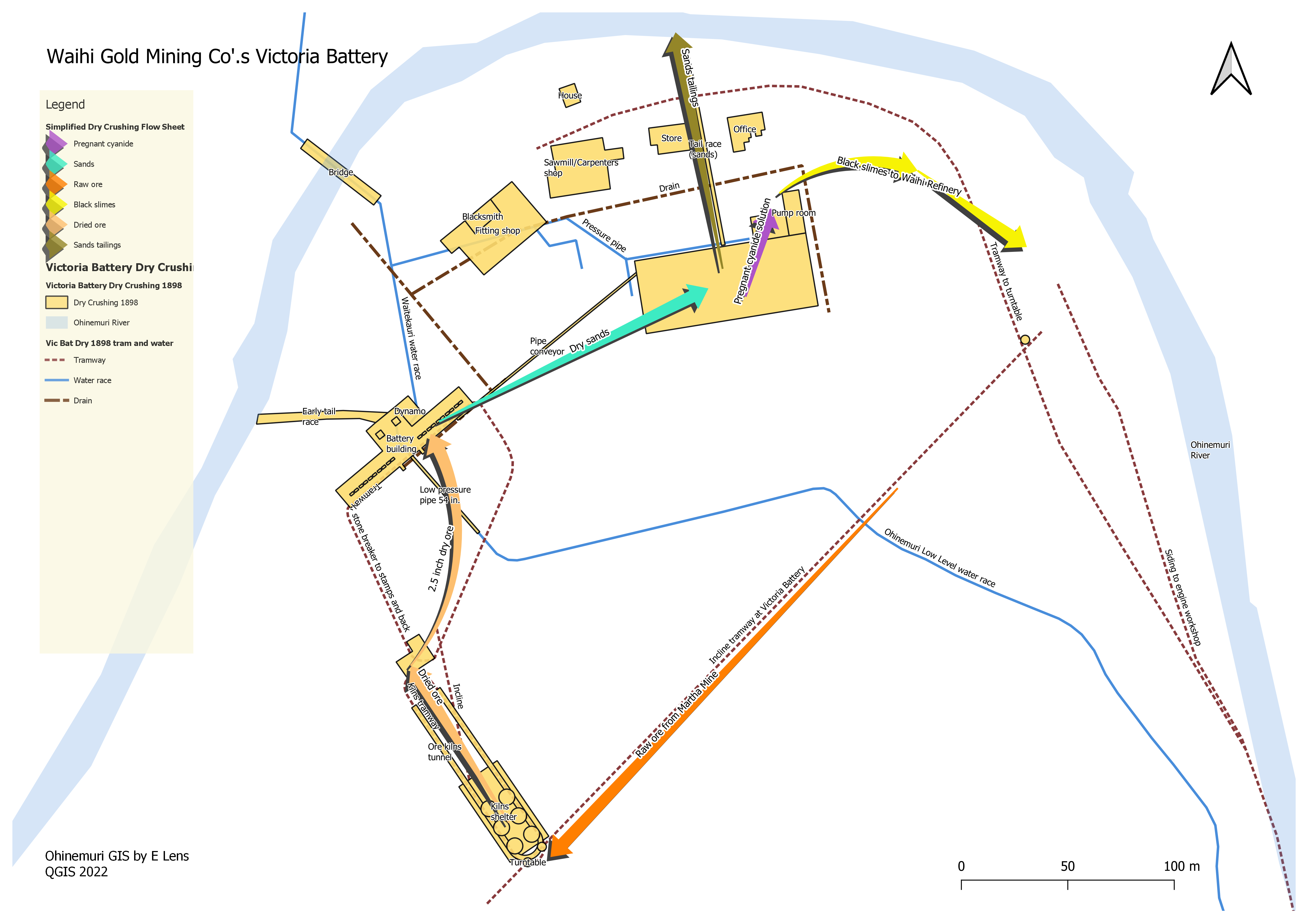
The Waihi Gold Mining Company established the Victoria Battery in 1897/98. 100 stamps commenced dry crushing early March 1898. The crushed ore (fine sand) was treated by cyanide percolation in large sand vats.
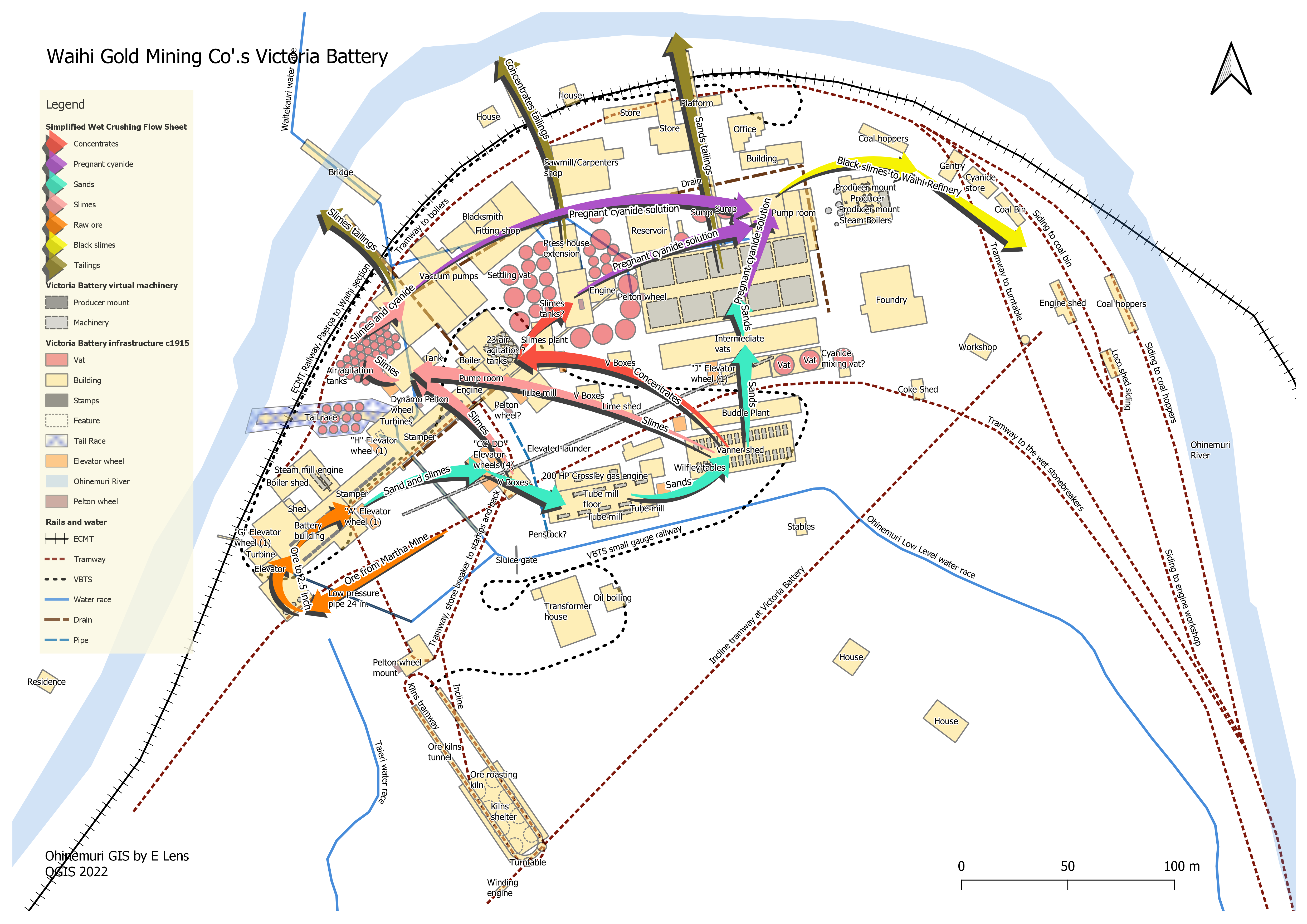
A further 100 wet stamps were added, and the whole battery started wet crushing early August 1902.
At this point the processes flow-sheet became more complicated, with sands, concentrates and slimes (very finely crushed ore) being treated separately. This arrangement proved to increase bullion recovery, but required specialised structures and processes to be established.
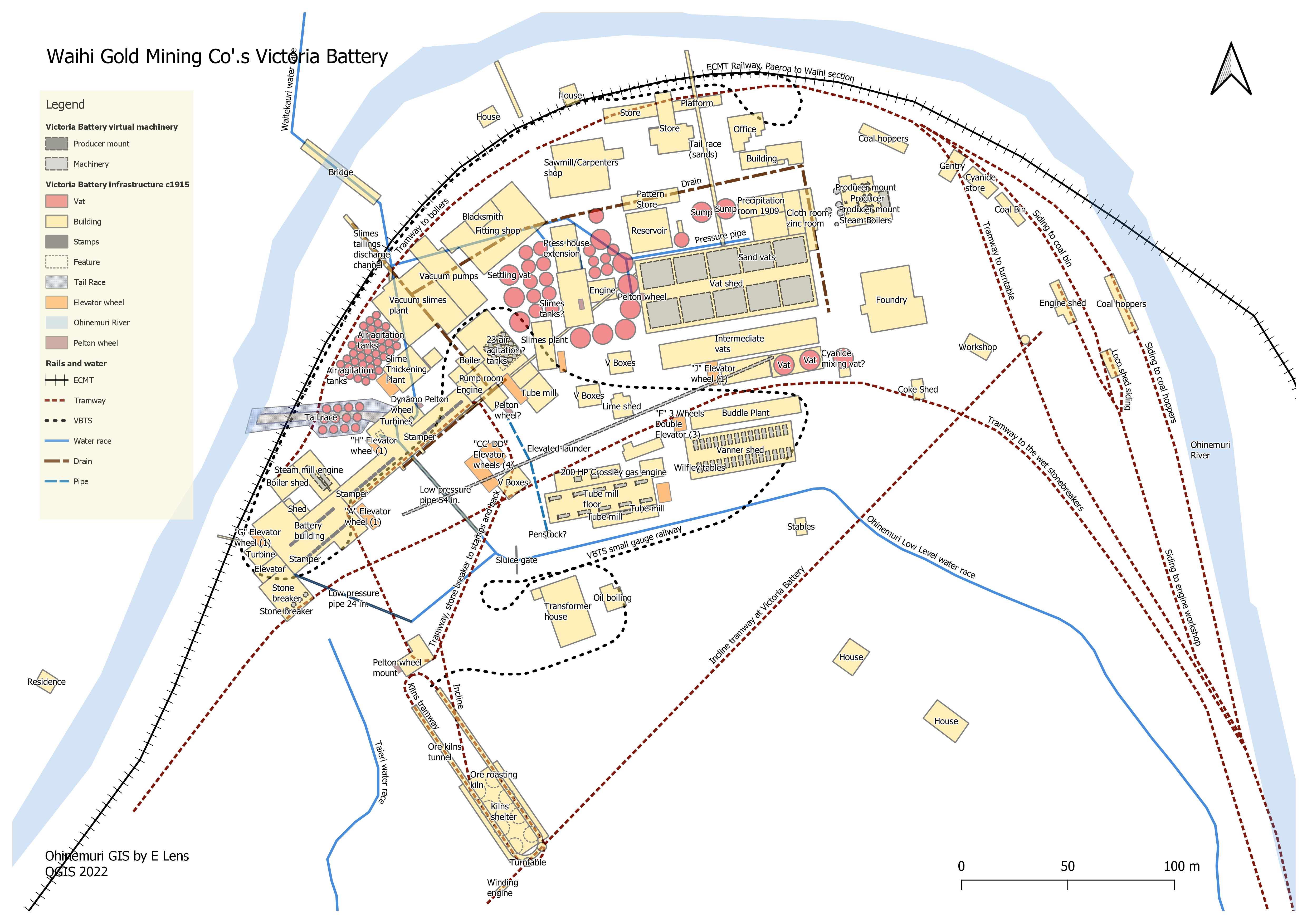
See the Victoria Battery GIS for interactive content and on-site navigation.
 |
 |
 |
In more detail:-
The Waihi Gold Mining Company established the Victoria Battery in 1897/98.
Waihi ore (and Hauraki ore in general) was difficult ore to process. Refractory, with gold finely divided and often intimately bound to sulphide minerals. Ore roasting and dry crushing followed by cyanidation had been established as best practice at the Waihi Battery, and thus this was the process set up at the new Victoria Battery. Huge ore roasting kilns were built, with vast quantities of firewood required. Miners and battery hands were maimed by “the dust” (phthisis or silicosis).
100 stamps started dry crushing on March 2nd, 1898.
The ore was crushed to fine sand and transported to leaching vats by pipe conveyor. Cyanide solution was percolated through the sands; there was no agitation. Percolation was only successful if there was very little fine material (called slimes) in the sands. Roasting and dry crushing mostly achieved this.
Experiments in wet crushing, over many years, were on going. The increasingly mineralised ore found at depth in Martha mine added to the pressure to convert.
In May 1899 a start was made to erect a further 100 stamps which were to be wet crushing.
By mid January 1900 the 100 wet stampers were fully operational . The original 100 dry stampers were converted during 1902 .
The change to wet crushing, and the more mineralised nature of the ore required changes to the battery flow sheet.
Wet crushing, without preliminary ore roasting, produced more very fine material (slimes). Slimes prevented the percolation of cyanide solution through the crushed ore (called pulp). The slimes had to be separated and treated by agitation. The highly mineralised portion of the ore proved resistant to the regular process, so was also removed, and treated separately.
The three products were separated from the stamper output and treated individually; sands, concentrates, and slimes. The battery buildings, machinery and processes reflected this. Alterations and refinements were made over time. The difficulty of agitating slimes was largely overcome by air agitation in tall tanks.